

Reader's Guide
In The Life of David, Robert Pinsky brings the biblical figure of David to life, teasing apart the many strands of his story—leader, outlaw, poet, warrior, son, father, lover—and then weaving them together into a vibrant biography of this most celebrated biblical king. The following questions are ways to begin exploring some of these threads.
Artist and Artistry
1. David is most often remembered as a warrior and king, but, like Robert Pinsky, he is also a poet, named by the Bible as the author of many of the psalms. How does this change our image of David? What aspects of his character are learned from the psalms Pinsky uses to illustrate the story? How might Pinsky’s life as a poet color his retelling?
2. Pinsky writes, “The hero requires the artist who celebrates him.” Why do you think so many artists over time—Michelangelo, Donatello, Rembrandt, British playwrights George Peele and John Dryden—have been drawn to David as a subject?
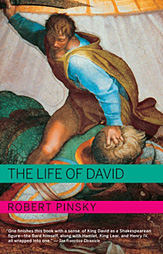
3. How is our image of David influenced by depictions of him in Christian art such as the detail from the Sistine Chapel that appears on the jacket?
4. How does language affect the telling of this story? Pinsky’s preference is for the Anglicized names of people and places and the King James Version. Would readers relate differently to the story if the characters were known by Hebrew transliterations of their names—Avshalom, Batsheva, Shlomo, Shaul—and if the English text was drawn from a contemporary translation?
Leadership
1. David’s reign as king reveals his strength of character as well as his flaws. How does David shed light on the biblical ideal of leadership?
2. Pinsky writes, “A hero is one who does great deeds and suffers for the good of the community.” While David’s deeds are indisputably great, does David suffer for the community? What are the causes of David’s troubles?
3. What qualities of leadership do David and Saul share?
4. David makes many mistakes in his reign, but is always forgiven by God who chose him and continues to promise him an eternal throne. Why is he forgiven and Saul rejected?
Fathers, Sons, Brothers, and Heirs
1. Like so many biblical heroes—Isaac, Jacob, Moses—David is the younger son who is elevated over his older brothers. What does the Bible suggest by repeatedly inverting the traditional order?
2. Fathers and sons are a recurring motif in this story: Saul fears David, his son-in-law, will turn his son Jonathan against him; David is undermined in various ways by his sons Amnon, Absalom, and Adonijah. How do David’s own actions—and inaction—contribute to the dysfunction of his family?
3. When the young David comes to fight Goliath, he is given Saul’s armor but, overburdened by its weight, removes it. However, he has no trouble wearing Jonathan’s garments and shield, given to him as a symbol of love. What does this reveal about the relationships among these three men?
4. How is Saul’s donning a disguise to see the witch of Endor different from what Pinsky refers to as David’s “shape-shifting”?
David in Love
1. The Bible so often leaves the women unrecorded, yet David’s story is filled with women, from his great-grandmother Ruth to his wives—Michal, Abigail, Bathsheba—to his daughter Tamar. What do these women teach David? What do his interactions with them reveal about his character?
2. How are the women in this story used as symbols of male power? Who among them manages to assert her own authority? Who fails to do so?
3. In another birth-order inversion, David marries Saul’s younger daughter, Michal, who loves him, instead of the older daughter Merab. Is Michal’s role in their relationship a departure from the roles of women in the Bible?
4. What went wrong between Michal and David? Are love and hate always as closely entwined as Pinsky makes them out to be in this story?
5. “Therefore Michal the daughter of Saul had no child unto the day of her death.” Is Michal childless as a consequence of the never-healed rift between her and David, or as a divine punishment for her disdain for his joyful dance of worship before the Ark?
Divine Justice and Human Vengeance
1. Both David and Saul employ a code of justice and vengeance that seems grounded in the biblical command of “an eye for an eye”—a system which the rabbis of the Mishnah, 1,000 years later, repudiated in favor of a system of paid damages. Why do these leaders so ruthlessly adhere to this often brutal code?
2. Divine justice, too, often functions in these stories as a calculated exchange, a system that is not limited to God’s prophets but is also the language of the magicians and divines of the surrounding gentile cultures. How is this different from contemporary ideas about justice?
3. When David sleeps with Bathsheba and then has her husband killed, he confesses and throws himself on God’s mercy in a psalm that has become the core of Jewish penitential prayer. Why does he insist that his sin is against God alone and ignore his victim? Is his confession sufficient?
A God’s Choosing
1. David, whose name means “beloved,” is chosen to be king of the Israelites after the first divinely chosen king, Saul, is rejected by God. What does the divine need to change and reassess the choice reveal about God?
2. David relates to God through the calculus of divine justice but also through a joyful spirit of celebration, seen when he dances exultingly before the Ark of God and when he prophesizes in Ramah. Yet Saul is mocked when he joins these same dancing prophets. Why does this behavior seem natural for David but alien, and even ridiculous, in Saul?
3. Why does God decline David’s offer to build the Temple? According to Jewish tradition, the blood of war on David’s hands made him unfit to build the house of God. Yet Solomon, who is permitted to build the Temple, himself wages war and kills his brother. Why might God prefer that Solomon perform this task?
David the Myth
1. Of the many great stories of David’s life—David and Goliath, David and Bathsheba, David and Saul, David and Jonathan, David and Absalom, to list but a few—which are the most familiar? What parts of David’s story came as a surprise to you?
2. In Jewish liturgy the Messiah is often referred to as “the seed of David” or “the House of David.” Why is David, rather than Moses or Abraham, the eternal leader of the Jewish people?
3. How do David20and the stories of his life continue to figure into Jewish discourse as symbols of the endurance of the Jewish people and, since its establishment in 1948, as symbols of the State of Israel?
4. Christian theology claims that David’s kingship is a prefiguration of Jesus. Pinsky recounts a midrash, a rabbinic story that attempts to illuminate the biblical text, in which David is shown to be the greatest of all the biblical heroes and leaders of the Jewish people. How does this explain Pinsky’s point that “David can be understood as rendering Jesus an afterthought, a precluded and showy iteration of David?”
5. Why might the religions that honor David—Judaism, Christianity, and Islam—emphasize some stories and not others?
Excerpt
Of the Thousand Great Stories, more than a few are about him. David and Goliath and David and Bathsheba of course, but also David and Saul, David and Jonathan, David and Absalom. Tales of battle, of sex, of the uncanny, of needy mistrust between the generations, of loyalty and betrayal, politics, incest. David and Amnon, David and the Witch of Endor, David and Abigail. The great neglected story of love and undying hate between a man and a woman, David and Michal, David and the doomed generals out of a Shakespeare history play, Abner and Joab. David and the crippled son of Saul, Mephibosheth. David and Abishag. And the implicit story of the remorseless wheel of time, David and Solomon. He is wily like Odysseus and an impetuous daredevil like the Scarlet Pimpernel. Like Hamlet, he pretends to be crazy. Like Joan of Arc, he comes from nowhere, ardent and innocent, to infuriate the conventional elders. Like the Athenian rogue Alcibiades he goes over to the enemy side for a time. Like Robin Hood, he gathers a band of outcasts and outlaws in the wilderness. Like Lear, he is overthrown and betrayed by his offspring. Like Tristan and Cyrano, he masters the harp as well as the sword: a poet as well as a warrior-killer, but as a poet he is far above any other hero, and as a killer no one among the poets can even approach him. He must have actually existed, and most of it must be true, writes the upper-class Englishman Duff Cooper, because no people would deliberately invent a national hero so deeply flawed. The flaws of Lancelot make that adulterer a more heroic knight than Galahad the chosen of God: David is both, flawed and chosen, as in the span of his life he is both the golden lad and the grizzled adulterer. The adultery exacerbated (or depending on perspective ameliorated or mystified) by the fact that as the prophet Nathan points out to him he already had wives and sub-wives by the dozen. We love our heroes at a level beyond reason, an intuitive plane where our shared feelings are tribal and nearly animal, rather than legalistic: as unheeding of priests and lawyers, though intimidated by them, in our collective public fascination with the hero as we are in our individual, private love life. A hero is one who does great deeds and suffers for the good of a community, but in addition the hero must be talked about. “Unsung hero” is a paradox. The deeds and suffering become heroic as we tell stories about them. So that anthropological figure of action needs the other figure who sings, who tells the stories. For the hero to be celebrated requires the artist who imagines the celebration: David the warrior-artist is both. He is the most manifold and various of heroes. His name is thought to have meant “beloved.” His world is a realm of multiple tribes. More than piety might like the Jewish and non-Jewish designations blur: Ephraimites, Amalekites, Benjamites, Maachathites, Harodites, Gileadites, Zebulunites, Carmelites, Pherethites, Ammonites. From the Zidonians Solomon the Wise in his old age contracted worship of Ashtoreth, the abomination—more gently known as the love goddess called Astarte by the Greeks and Ishtar by the Babylonians. A deity of fruitfulness as well as beauty. Her followers among the ancient Jewish tribes left a little stone image of her that survives with other ancient artifacts among the much later six-pointed stars and the seven-branched candlesticks in the Jewish museum in Los Angeles: the lady Astarte who embodies some of the attributes of Solomon’s mother Bathsheba. Astarte or Ishtar is echoed in the name of the Jewish heroine Esther, who in the weave of syllables and legends became the consort of King Ahasuerus, which is to say the Persian ruler Xerxes I. As the bloodline tangle of tribes indicates a world of overlapping shadows and smoky alliances, geographic notions too must be imagined as shifting, each place with its countless layers of demarcation and language. The deceptive familiarity of place-names adapted into English—Shiloh, Gilead, Gaza, Bethel—should be balanced by less assimilated names: the Wilderness of Ziph, Ashdod, the City of Dagon, Helam, Nob, Kirjath-Jearim, Shalisha, Ziklag. Immediate as a dream, in a setting as remote as the planets of science fiction, David’s career with its temporary victories and enduring glories, its obdurate calculus of pain, plays out a fundamental drama of all life. Overlaid by a system of rewarded piety and punished defection, a system embodied by the prophet Samuel, David’s drama enacts forces of ambition and destruction, love and betrayal, volcanic strivings and appetite. The story manifests an undying wonderment at the spectacle of a beautiful boy who pursues his course and flourishes as a dominant hero, and then becomes an anguished old man. That relatively secular story, the story of King David’s career, was written probably in the time of Solomon (the tenth century B.C.E.)—that is, a generation or two after the events—by the author scholars have called the Early Source. The Late Source, compiled and edited hundreds of years later, adds what I have called the overlay of divine punishment and reward, including Samuel’s strange and eloquent warning to the people about the nature of monarchy (“This will be the manner of the king that shall reign over you”). The Early Source tells virtually all of 2 Samuel, the account of David’s kingship and the destiny of the people of Israel; the Late Source tells the life of Samuel in I Samuel, and contributes the narratives of how God’s punishment deals with Saul and before him with the corrupt and idol-worshipping sons of the prophet Eli. The Early Source is largely a nationalistic hero narrative. The Late Source is largely a religious moral narrative. Still later editing and interpolations imposed by a Deuteronomist or committee of Deuteronomists further emphasized the principle of obedience to God. Other scholars have seen pro-Saul and pro-David sources. The frayed narratives, the peculiar knots, the clashes and oppositions, even the narrative contradictions of these strands do not produce mere incoherence. Rather, in the way of texts that have formed us for centuries, the meldings and inconsistencies of competing voices make the text read the reader all the more deeply. Because the Late Source tries to pull the story away from the monarchy and toward theological meanings, the career of David becomes an even more urgent, enigmatic account of destiny and freedom. Because it has been made to issue from the opposed story of Samuel (and Samuel’s interpretation of the story of Saul), the story of David is all the more magnetic, tormented and glorious. With its emphasis on competition and succession, loyalty and rivalry among men and between sons and fathers, it seems a male story, in the primal way of ironbound tradition; yet women play powerful roles. Michal, Abigail, Bathsheba, make decisions that determine outcomes. The matrilinear chains, counter-tune to the male begettings, manifest the way all stories, in fact all people, owe their being to origins multiple and unknown, a tangle of forgotten roots. The Moabites (and thus David) are said to descend from the cave where the daughters of Lot got their father drunk and tricked him into lying with them—like some scandalous story from Ovid or an Inuit origin myth. As an Ephrathite, David belongs to the one tribal group named from the matrilinear line: Ephrath was the wife of Caleb, great-grandson of the tribal patriarch Judah. The stories of the girl Abishag, the matriarch Ruth, the wives Bathsheba and Michal, gesture toward mythologies and histories and psychological imperatives beyond the masculine tribal system as they are outside the later theologies. What covert or defiant hunger harbored that image of Astarte? Or is the story of Lot and his daughters an ancient, mischievous insult, a Hebrew invention to taunt the Moabites— with the Hebrew David’s descent from Moab a forgotten or unanticipated twist? Or an added layer? A braiding-together of cultures or a cleaving-apart? These are the histories earlier than the Early Source, and more fundamental: the infinite regress of obscured Sources behind everything that survives. Subterranean fires and currents, forming the stories that form us, make themselves visible in the career of the hero. Copyright © 2005 by Robert Pinsky. Reprinted by permission of Schocken Books, a division of Random House, Inc.